


This is a travelogue & the idea is to share our experience during travel & provide information on what we saw / heard / gathered from our experiences & conversations. This is not an authoritative research paper on the Tribes of Odisha.
In a nutshell:
A rich, humbling, thought-provoking, experiential trip to the interiors of Odisha to meet, chat with & experience the life & culture of the people who have stuck to their tribal customs & way of life…..


Address & other details: click on the links below
Vana safaris – Facebook, Instagram
Desia koraput – Facebook, Instagram
Chandoori Sai – Facebook, Instagram
Disclaimer: All restaurants / eateries / Hotels / travel companies reviewed by YUMMRAJ were visited by YUMMRAJ himself & he has paid for the full Bill & tips also. http://www.yummraj.com does not have even one featured / sponsored reviews. YUMMRAJ believes in going to a restaurant in anonymity, as a normal guest, experience everything & give a honest account of the same to you.
Cost of the trip paid was paid by YUMMRAJ to Vana Safaris by UPI payment transfer. From that, Vana Safaris have paid all the expenses of the trip.
Each section of this post has headers, so that you can skip a section if that does not interest you. Here is a jist of all the sections:
Contents:
- Vana Safaris – the company which gave us the idea of this trip & did the execution as well
- The places that we stayed at – Desia & Chandoori Sai
- How & where we met the members of the tribe
- The markets
- Bonda Tribe
- About Other tribes we came across
- Accommodation
- Food & Drinks
- Our Village walks
- Major Occupation
- Places we saw
- Religion & beliefs
- Incidents during our trip
- Clarifications
Description:
Vana Safaris:
So happy that Avijit Sarkhel, Founder of Vana safaris, suggested this trip as an option & then arranged it for us as well. Without Avijit, we would not have been able to put this trip together on our own. Read about our earlier trip with Vana Safaris here – Sunderbans
This was the sequence of events –
- We did a call with Avijit last year to discuss interesting but unusual places in India – He suggested Odisha tribal areas, unusual places in Kashmir & some places in Himalayas. We zeroed down on Odisha after the call.
- Avijit emailed a background of the place & ideas.
- After reading the email, we had several rounds of discussions with Avijit & we finalized the trip.
- Avijit gave us a list of 5 books as pre-read before the trip. This, he said, was an important part of understanding the context better. We managed to buy & read two of the five. In hindsight, that was a marvellous idea. Beore reading the books we knew very little about Central India tribal way of life.
- Avijit sent a final itinerary by email with details of each & every, smallest of things. The email also included suggestions about clothing, footwear, things to carry with us etc. In short, he ‘set expectations’ very well.
- He also mentioned that people (guide, driver etc.) who would travel with us, would be given an RTPCR test.
Bibek ji (Bibekananda Mishra) was our guide throughout the trip – he was very knowledgeable on the subject & has a ‘never give up’ attitude. If he did not know something, he would say ‘I will get back’ & in most of the cases, he did.


Ramakanta drove us around the entire week. Great guy. Wherever he was, he needed his several cups of tea everyday & a newspaper without fail. That’s all that was needed to keep him going.

Avijit kept in touch constantly with Bibek ji, to check if everything was Ok. He also was constantly suggesting interesting new things to do, in addition to his email plan shared earlier.

It was a fabulous trip from planning stage to final, on-the-ground execution. ‘Seamless’ in one word.


Just one point that I would want Vana Safaris to think about, for their future tours – It should be made mandatory for all drivers to have a GPS & whatsapp enabled phone with Jio & BSNL dual SIM, because, in the last two years highways & major link roads have dramatically changed . New Highways, flyovers, underpasses etc. have come up in many places & the old ones are shut / abandoned. Old road signs are not there at places & landmarks have also changed.

In our case, Ramakanta had such a smartphone with him till COVID hit us all. He had to give it to his daughter so that she can study online. Practical problem with no alternative for him for sure. So he was with a non-smart phone on this trip & had no access to google map & whatsapp (for us to share location if we had walked away from where he dropped us).


The places that we stayed at:
We heard of a total of 63 tribes in Odisha each having a different language. We met members of Bonda, Mali, Gadaba, Paraja & few other tribes.
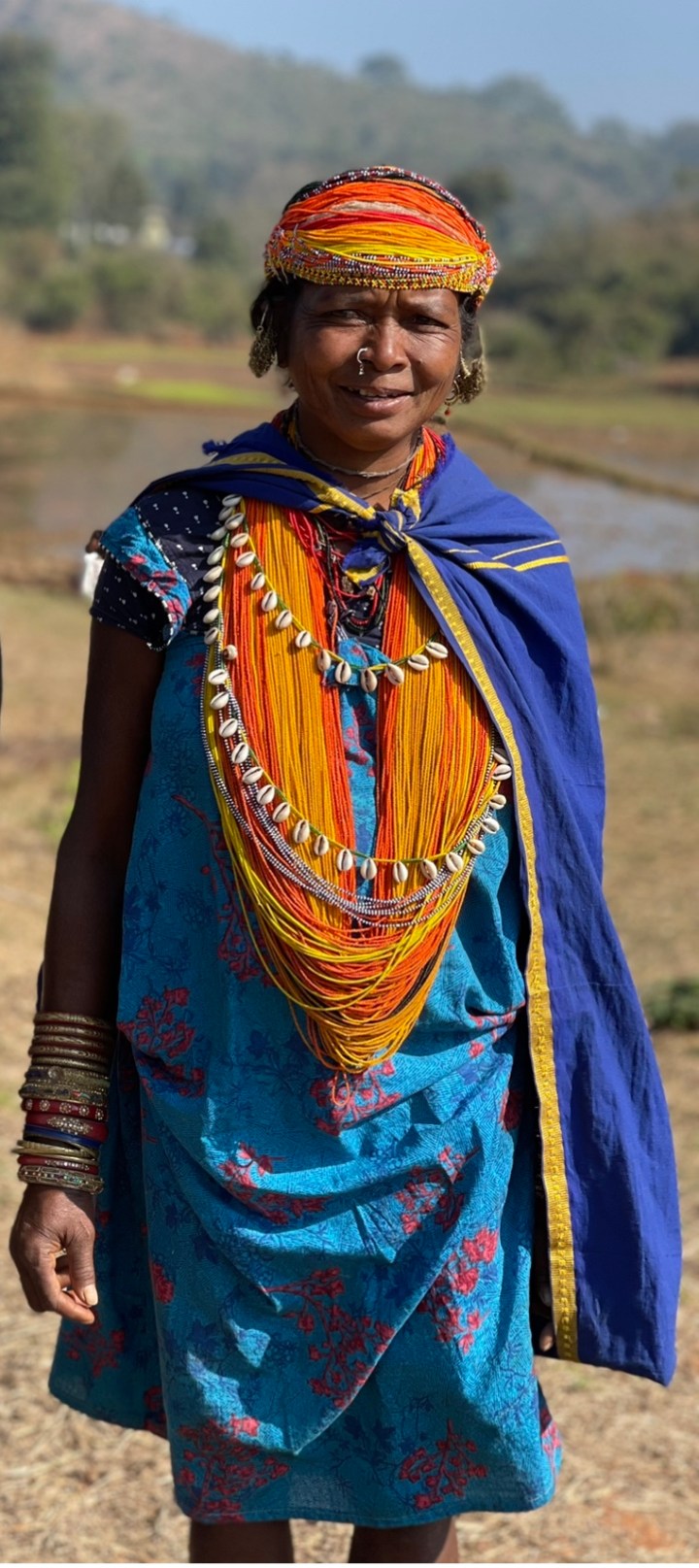

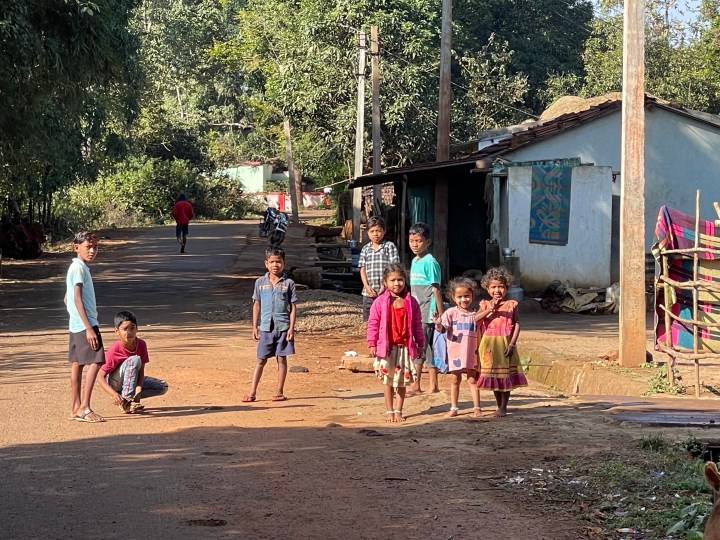
We stayed in villages where the members of these tribes reside.

One of the places we stayed was Desia at Koraput–Machkund road, at a place called Bental biri & the other place we stayed was at Chandoori Sai, located in a village named Goudaguda. Links to their respective website, Facebook & Instagram pages are given in ‘address & other details’ section.


Desia Koraput is an eco-tourism social resort where the buildings are made using a mix of modern techniques & traditional. Designed by Mr. Bidyut from Shantiniketan, we heard that artisans from the gond tribe were brought in here to re-create the unique tribal design here. The art work reminds of the creation of Sona Bai – Read here.


Desia eco resort is run by a group of young boys & middle aged ladies from the adjacent Gadaba tribal village, with no supervision (like in a traditional hotel) by a full time manager. The owner, a hotelier, stays in Bhubaneshwar. See the video here: video


The employees engage in farming of vegetables in the resort & guests are served food cooked from fresh harvest everyday. We enjoyed outstanding, distinct, different tribal food in all the meals here. Watch out for separate detailed post on stay, food & beverages at Desia in the next few weeks.


At Desia we saw a bunch of village kids who had come to attend study classes. Desia pays for these children’s education.

We noticed a room full of sewing machines. Later we saw young ladies from the village come & learn sewing, to start a career.




Chandoori Sai is owned & run by an Australian gentleman, Leon, who has been in India for the last two decades. Chandoori is a variety of mango – there is a chandoori mango tree near the entrance of the guest house. Sai means ‘road’ in local dialect. So it adds up to ‘chandoori mango tree avenue’.


Leon had designed, created the 5 room + 1 cottage resort from scratch with the help of local artisans & (initially) untrained girls from the tribal village – floor tiles made by potters, furniture & woodwork by local carpenters, bricks made locally, colors of walls from local plants etc. The result – A building that blends into the local village style of huts visually, yet is a very modern building with modern comforts.


I would rate this property at par with some of the best Taj safari properties.
Over time, Leon trained the village girls in plumbing, electricity maintenance etc. & also in cooking global cuisine in a modern day kitchen. 5 girls & a gentleman work with Leon now.


Leon runs a ‘one man show’ when it comes to all ‘white collared jobs’ of the organization – CEO, HR, finance, marketing, sales, projects, business development, visual merchandising, executive chef & everything else that an organization has. …. It was very inspiring to see how he had got into details of every single thing & implemented it so well, while never taking his vision off the big picture.


Best part of stay at Chandoori Sai was the long chats with Leon, eating the ‘made from scratch’ food – pasta made from dough, breads baked in-house, apple pie, caramel custard etc.


The conversations with the girls was also very interesting – we were asking about their traditions & way of life. They were asking us about ‘big city life’& then they asked us to show pictures & videos of how our house looks like, how it feels to stay so high up, in a multi storeyed building etc.
Watch out for separate detailed post on stay, food & beverages at Chandoori Sai in the next few weeks. See full video here: video
In both the locations, there was huge temperature difference between day & night. With one blanket it was like borderline shivering cold in the nights. In day with only tee shirt, we were sweating. We have No idea of actual temperature as mobile network was not there & hence no access to google.
In certain places, under certain trees near Desia, there would be a bunch young boys & girls stationed on & around motor bikes. Even at night. We got to know that those are the particular spots known to locals to be getting ‘jio’ network. Other networks do not even exist / do not port to jio when phone is put to automatic network choice.

Infact, we saw children studying below these trees since a lot of schools & colleges are currently teaching online. Someone jokingly told me ‘going to ‘jio mandir’ to connect to rest of the world.’
At Goudaguda, for Amazon deliveries, the courier company calls the customer a day in advance & asks to go to a place called Damanjodi (few kilometers away) say at 11 am in front of temple. Once there, the recipient finds a lot of people waiting to collect their merchandise !!!!
Everywhere we saw kids, even in the remotest of villages, they said excitedly ‘iPhone’
How & where we met the members of the tribe:
Apart from our interactions at the resorts, we met members of the tribes at –
- Weekly haat (markets)
- During our numerous ‘village walks’.
We visited 3 markets –
- Thursday Onukudelli – Bonda, gadaba & Mali tribes. see video here – video
- Friday Kunduli – Mali & Paraja tribes
- Saturday Laksmipur – Mali & Paraja tribes
The markets:
The markets were mostly open area where people were setting up makeshift stalls – 4 bamboo sticks on each corner & a cloth top.
See video here: video


Or they were just sitting on the ground with their merchandize displayed on a cloth.


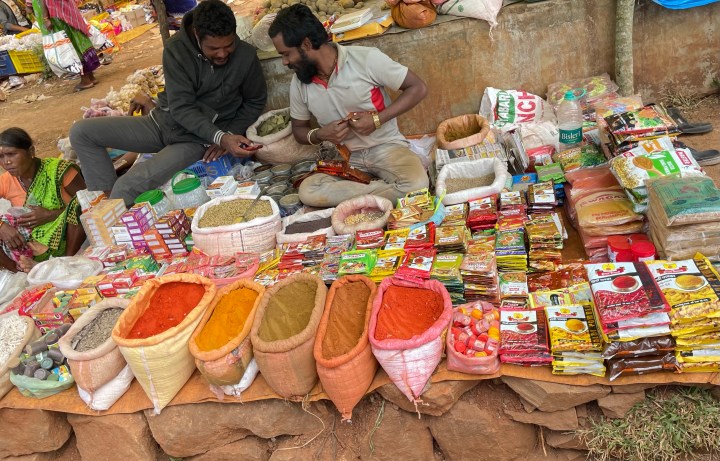


I was impressed with the visual merchandizing of a man selling junk jewellery.

Kerosene oil, salt (locally made salt / tata salt) & dry fish are the main thing they come to buy in the market. Barter is still common. If someone has more money, then they buy other things.

Almost everything edible in the market was being sold in denominations of ‘kuri’ meaning ₹20. So the quantity of goods would vary as per market factors but the denomination would be twenty.


Exceptions to the ‘kuri’ were stalls selling sarees / footwear etc.


In the markets, we were the only ones wearing masks.
Bonda Tribe:
One of the most primitive tribes in mainland India is Bonda tribe. They stay in Malkangiri district of south Odisha, atop hills. Due to very high infant & overall mortality rates (as compared to rest of India), their population was reducing. In 1977 the government had formed a body named bonda development authority which has done some work of upliftment. Inspie of this, there is very low literacy rate among adults. It was good to know that many of their Children are now going to school.


‘Bonda’ means ‘man of the forest’. They speak a language called Remo which is slowly getting replaced by Deshia – a mix of tribal dialects & odia
The male members of the tribe were not very tall – approx. 5 feet. They have Afro mongoloid features. Sadly their average age is 40-45 even today as compared to a national average of 70.
The men make & drink a lot of alcohol regularly & are very well trained in hunting / fighting. So we heard that some people from the cities find them to be a bit edgy. Alcohol, not so good nutrition (poverty) & not having full faith in modern medicines (till a very late stage, when all else has failed), is probably a reason of low life expectancy.
We heard that Till 1995 child mortality was as high as 80%. Then the Government sent people to stay with them in their villages, to help them with health facilities & contraception. Health facilities helped a little but contraception backfired initially. Opening of schools & a generation getting modern education made some difference.
Among Bondas, earlier there were many instances of 12-13 year boys marrying 18-20 year girls. The girls would take care of the boys in the initial years & the boys would reciprocate it when the lady got old.

It is said that ‘the bonda Male behaves like lion – does no work. The woman does all work, raises child, earns & also gets share of all inheritance’.
Food – They eat rice throughout the year, miscellaneous roots that grow in the jungles, tiny local tomatoes & tiny potatoes (Maati aloo), other vegetables, lentils, chicken. Beef is eaten in major occasions like marriages. The father of the boy has to treat the village with meat & alcohol.


If divorce happens due to the lady moving out with another man, then the new husband has to return a cow to the old husband & also pay money.
Bonda Men traditionally wear just a loincloth around their waist. We saw older men stick to that dress code. Some Younger men were in tee shirts & shorts too.
Bonda Women were decked up in lots of ornaments. Traditionally they too used to wear a single piece of cloth around their waist & cover the upper body with ornaments only.
Nowadays many ladies were wearing new bright coloured sarees wrapped around in Roman Greco style. Some others who probably find it too messy have started wearing cotton night gowns.
We met a cheerful Bonda lady whose name is Budai. Our guide knew her from before. She told us that she had bought the beads & cowries from the market & made her own necklaces & headgear. The beautiful Earring she mentioned, was bought from one of the haats.
She stays 14 km away in the mountains. She had come walking all the way with whatever produce she had (be it farm produce or anything she has made) & would have to walk back with all that she bought, on her head.

About 4 km from market there is a small shop. After that, there is no shop till her village.
We met Budai in another market after about an hour. We were buying small bottles of thums up. We saw her from the shop & got one for her too. When we gave it to her, she gave a very warm smile & then blinked & said ‘biscuit gift’. We said ‘of course’ & we asked her to choose which biscuit she wants. She finally chose a pack of namkeen.
These modern day city snacks are not found in her village. So while the local roots, baby mountain tomatoes & river dried fish were exotic for us, for her the urban snacks were exotic…
The bonda ladies also wear multiple bangle-like chokers in the neck – made from white metal. We got to see that one of these chokers is made from brass – that is expensive. We got to know that the brass one is traditionally received at the time of marriage & is worn till last day of life – given by mother in law to daughter in law.
About Other tribes we came across:
Ladies from the Mali tribe wear three rings on their nose.


Members of the mali tribe started cultivating long back, before many other tribes got to farming. They started farming while the other tribes were still hunting-gathering.
The members of Mali tribe nowadays mainly do flowers & vegetables cultivation & sell these vegetables at the weekly haat. On non-haat days, they sell flowers to temples.
We got to know that among most tribes, Boys marry at an age of 18 years & girls marry after puberty.
We got to know that among most of the tribes, there are two kinds of marriages –
- Jhinka Kania – Boy & his friends snatching the girl in front of all. The boy thereby displays ‘daring’. Then the girl’s family goes to their house to determine money for the marriage feast. The boy’s family pays the girl’s family a sum of money, in addition to cost of feast (reverse dowry).
- Arranged marriage.
Boys have to build a separate House for themselves before getting married, in most tribes.
Accommodation:
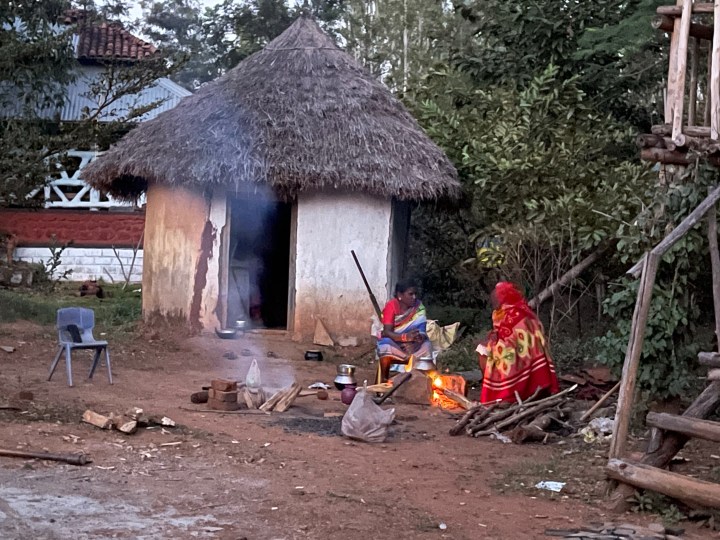
- Old houses were built from mud, sometimes mud & stones. The structure of mud houses used to be built with bamboo.


- New houses are being built with fly ash bricks. We saw the men & women of the house (family members) working as unskilled / semi-skilled labour to build their own house. Professional Mason is hired by the family as technical expert & project manager.

See video of old house here: video
- Outside a house was written ‘Manju Weds Bhima’ in English. It means this is Manju’s house & Bhima came here to receive her. At Bhima’s house it would be ‘Bhima weds Manju’.


This is what we heard about setting up of villages:
When a village seems to become too big & the natural resources start falling short, one Man ventures into the hills & finds a good spot to set up a new village. The Requisite for setting up a new village are –
- Free flowing natural source of Water &
- Hill on one side at least, if not on multiple sides, like in a valley.
He then moves out of old village & sets up huts with friends & family who move out with him.
When youngsters are ready for marriage, the arranged marriage partner is often found from other villages because in the initial stages, almost everyone in a village is from the same extended family.
Slowly over generations village expands.
Food & Drinks:
- Members of all tribes eat rice throughout the year, miscellaneous roots that grow in the jungles, tiny local tomatoes & tiny aloo, other vegetables, lentils, desi chicken.
- Beef is eaten only by people from Bonda tribe, in major occasions like marriages. Most tribes eat pork but this is not a regular food item like it is for many tribes of Nagaland & Assam.
- Tea shops are not to be found here but home brewed alcohol is sold by many people in all markets.
- When we went to meet a lady at her hut, she offered us salpi instead of chai – we drank & loved the Salpi/sulpi (drink made from local palm)!!!

- We also saw a women’s bar. Ladies sitting around chatting & drinking and having a good time.
- On the Last evening of our trip, our driver Ramakant Ji went for a stroll in the village & ended up at the home shop (a room of a village hut converted to a shop, transaction taking place through the window), where he had tea & pakoda the previous evening. The child at that house who was near the window, said ‘sorry we can’t serve to outsiders as per tradition, because today is Saturday’. Ramakant Ji told the kid ‘next door tell mom I will pay ₹20 for only hot water. I will make my nescafe. Tea sells for ₹5 per cup. Kid went back & convinced mom to give hot water!!!
- We saw two ladies in the market selling some drink in the market. It was Dahi that they had made at home, served in plastic glass, with salt & red chilly powder. Potent curd. Strong flavors. The curd was very good & high on sour.


- We absolutely enjoyed Koraputia food under the tree, organized by Bibek ji.
A stream was floating past


Step farms were located just outside the enclosure.
We sat on a madur (mat) on the ground.
The food was served to us on a banana leaf.
A tribal lady & a man from the village (paraja) had cooked the entire meal.


This is what we ate –
Mandia balls – a millet steamed in the shape of a ball, eaten as a cereal, with daal & vegetables. We had eaten ragi mudde in our numerous trips to interiors of Andhra Pradesh earlier. This was similar.
The rice was perfectly cooked, aromatic.
Daali – local daal was more like lobia but different. Perfectly cooked – soft enough to be enjoyable & firm enough to have a bite. The ‘jhol’ or super thin liquid of the daal was just too good. Loved eating this with mandua balls.
Sarson saag was cooked with onions – very distinct flavour, texture & taste of the saag, unlike the commercial version of a paste like sarson saag served in north India during winters.
Desi murga curry – This was real desi murga, unlike the farm bred desi that is being sold in urban areas of India. These murgas & murgis are athletic, have more bones, less muscles, almost no fat & outstanding to taste. Can beat an average cooked mutton curry!!!!


Our Village walks:
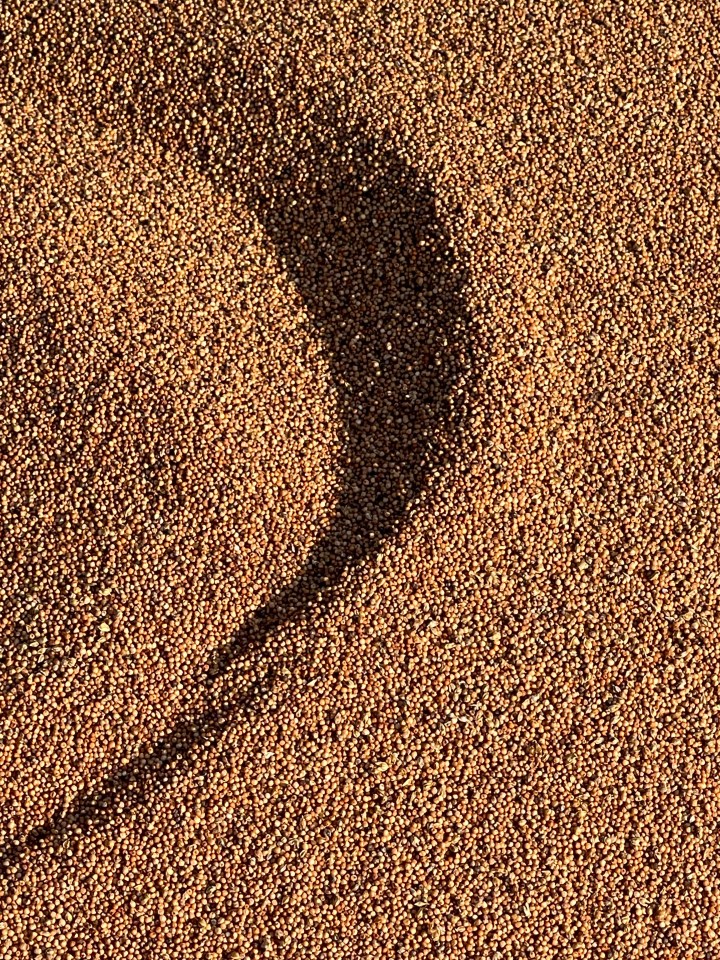
- We saw Mandua millet, kept on the ground after thrashing.
- A Truck had come to the village to deliver ₹1 per kg rice to be sold to BPL (below poverty line) families having a BPL card. Each family gets 25kg rice per month.

- Hay is kept by the villagers on a machaan so that cattle don’t eat it on their own but can eat only when given by their human masters.




Major Occupation:
Due to a mix of the following, many people from the tribes (especially the ladies) spend an extraordinary time each day in doing activities just to sustain life.
- sticking to traditional way of living. e.g. collect wood, cut it to small pieces, set up oven, cook (slow), go to fetch water etc.
- lack of exposure to the modern way of life, that have made things easier – use of tools & machines.
- Poverty – unable to afford modern day facilities.
Most people are into farming & gathering. Rest are into pottery, metallurgy etc.
We saw a team of Kamar (iron smiths at work). Customers were getting custom –made equipments made for themselves here.
Some others, who consciously embraced the changing times, got educated, have done differently. Some better, some not.
We were chatting with two boys in the Desia team. I asked about their school. They said the name of their school & described the location. Then one of them mentioned his college. I asked ‘have you graduated?’ The answer was ‘yes, I Used to work in Mahindra showroom in the city earlier. However, then I felt like staying in village. So took up a job here. Been here two years. ‘
We met Dharmendra ji, a local landlord (paraja tribe), who now owns more than 200 acres land. He was kind to show us around. He used to go to school 5 km away walking. Village schools were not there in those days. His College was 40 km away. Now there is a college much nearer.
Dharmendra ji currently is into full time farming – Vegetables, Rice, dal etc. He said Traders come & collect vegetables from all farmers in the mornings in small vehicles & sell them at mandi. Dharmendar ji also owns 200 cows & 150 buffaloes. The cattle graze in the natural greens of the mountains.
Places we saw:
- 11th century shiva temple in Nandapur. On the walls of the temple were carvings of a lady watching herself in a mirror & another lady blowing a conch shell.


There was also a statue of a Lion atop an elephant.
- Sati Stone at Nandapur – a stone plaque remembering a sati. It is said that Sati started, to prevent victorious Islamic conquerors from abducting & forcefully marrying the defeated (killed) Hindu king’s wives. The King’s widows would jump into the pyre of their dead husbands & burn alive, rather than get abducted. Later this became a common practice for many families & in many places girls were being forced into sati. Raja Rammohun Roy, a social reformer, took help of the British rulers in early 1800s & got sati to be abolished by law.
The sati stone we saw, had the Emblem of sun & moon. It also had etched, a hand of the sati lady, reaching out, perpendicular to the ground, denoting she was alive when the pyre was lit.
- Ruins of jain tirthankar temple from 7th-8th century, which had now being converted to a hindu temple. The Tirthankara could be seen in a meditation pose & a lady seated at a panel in the bottom.


- Duduma waterfalls

- Nishani munda temple : Goudaguda Village tribal temple – This was Just a boundary around a sacred tree. The open space in the middle is nowadays used to conduct ceremonies. Paintings on the wall depicted events in life – marriage, birth, hunting, sacrifice, celebrations etc.


- Kutnipada temple – we saw Tribal version of Binshabhuja durga (Durga with 20 hands), Gumfa shiva linga & a unique statue of jagannath in lying down posture (like vishnu’s anant shayya). Of course the weapons were being worshipped too, as per tribal customs. See full video here : video


Religion & beliefs:
- Religion – Traditionally they pray to Dharati Penu (mother goddess- earth), hills & the forces of nature. They also pray anything Unnatural – like an unusual looking stone/ hot water sulphuric stream, Bamboos with spikes. We saw that many hindu gods & goddesses have also entered their temples.
- We went to the house of a lady Village ‘shaman’ – who prays, gets ‘possessed by divine powers’, gets into a trance & heals people.


Outside the gate of the shaman’s house, there are two idols of tigers – garlanded.
The Shaman wears a jata on her head (matted hair due to not combing / washing the hair)
Bibek ji requested her that we had come from far & wanted to watch her in action, healing people. She agreed to this & asked us to sit next to the puja area.
When we sat at the puja place, we met a little child who had come with his grandmother – the grandmother said ‘bhut (ghost) has captured the child’. So the child had been brought here to get rid of the bhut.
The lady shaman explained to us verbatim, while beginning the procedure – ‘Earth is my mother, Divine being is my father, I cannot read or write, I have not received any formal education, I am ‘tip chaap’ (capable of doing only finger print signature), I can speak little bit of many languages when I am possessed – I have not learnt those languages ever, it comes to me when I am possessed by the Special powers, all this started when I was 12 years old & I don’t know till when I will have these powers, it’s my fate, I try to serve people, I do not take any money from anyone, Rogi ke ami uddhar kore anbo (I will rescue the patient from the evil spirit & I will take the evil inside me’.)
As she started the puja, she kept on saying things in a rhythm in different languages. I heard several words like Ram, Saraswati etc. & also heard words like treta yug, munda etc.
At some point she got into a trance & kept moving. After some time the pace started slowing down.
Child was given a holy water at the end
See full video here : video 1, video 2, video 3
As we got up to leave, Bibek ji asked her about what we should pay. She said she does not accept money from anyone. Even ‘patients’ get her produce that they have grown in garden / artefacts that they have made themselves. That’s when we remembered that the grandmother had given her a small bag when she had entered.
Can’t forget the amazing experience of seeing the making of a Dokra metal idol / artefact by award winning artist Banno Nayak Ji at desia. See video here: video


Incidents during our trip:
- The last night we spent in the village, a man in his mid-forties died. He drank a lot, passed out in the open & eventually passed away due to cold. Ladies of the village took the dead body to outside the cremation area. The boys came separate & they made the pyre & lit it. Then the boys took bath, wore new dhotis & did some puja. We heard that there will be a drinking ceremony in the evening to remember the departed.





Clarifications:
- To ensure we do not carry COVID virus with us to the tribal belt, we stayed & worked from home for two weeks before the trip. Though it is not mandatory, we got an RTPCR test done, in addition to being double vaccinated.
- We requested every tribal person we photographed & took their permission. We did not want this trip to end up being a Human safari. We rather enjoyed talking to all people we met – with us speaking a mix of Bengali, hindi & them speaking deshia. Rest was just facial expressions, gestures & loads of smiles…..